

Annie Comtois: When the voice becomes inner territory

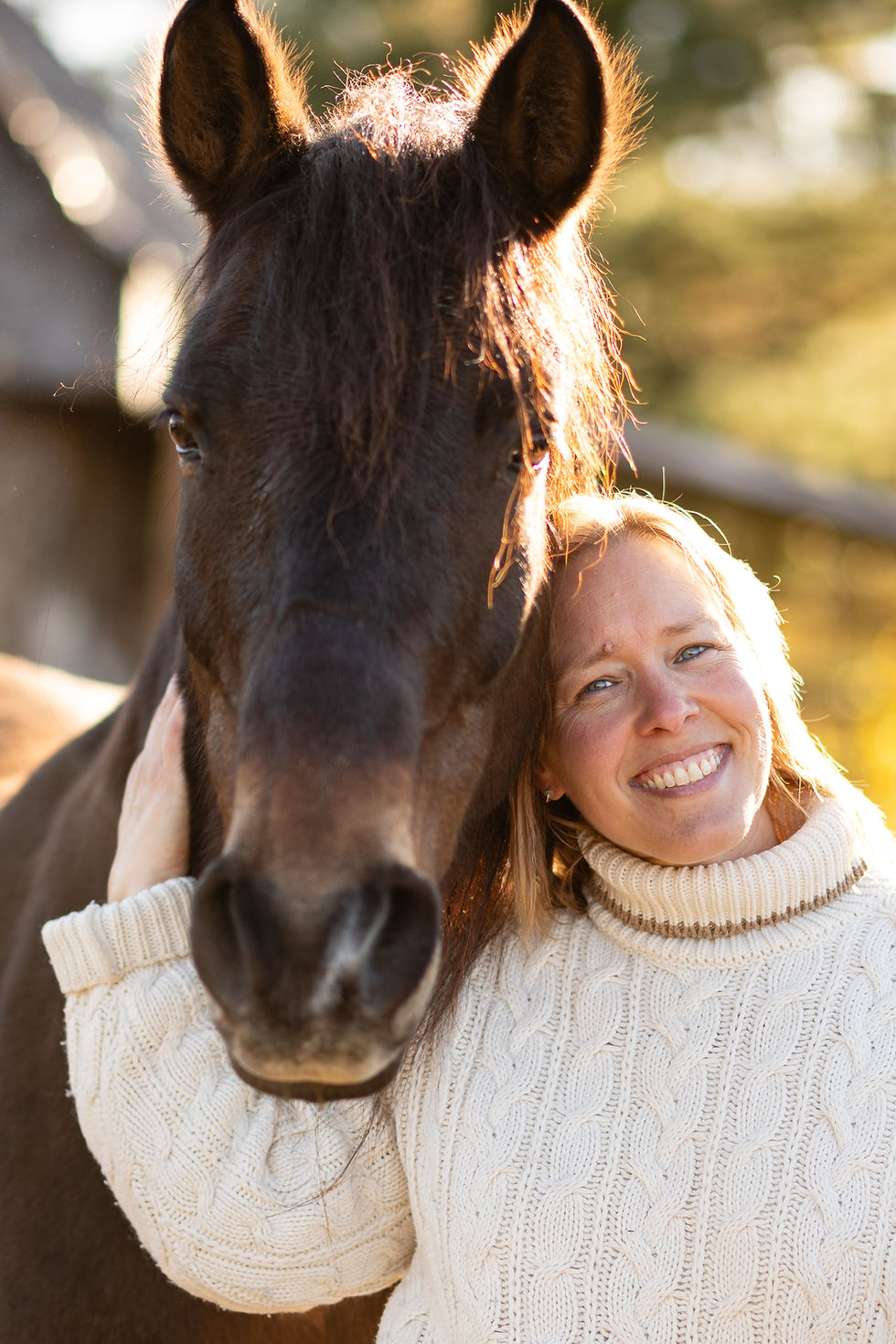
There are people whose presence touches you before they've even finished their first sentence. Annie Comtois is one of them. A conscious voice coach, she guides heart-centered leaders, those who carry a mission greater than their ego, to release what she calls their voice of impact. The one that trembles a little sometimes and that, precisely because of that, reaches others.
Our meeting, as part of the Offbeat conversations, lasted the length of a conversation that didn’t want to end. And for good reason.

A journey woven of voice, stages and silence
Annie’s path toward voice coaching is winding and fully alive. A singer for twenty years, host, storyteller, passionate about dramatic arts and literary creation: it is in this rich soil that her practice took root. Voice coaching itself began more than 18 years ago. Mindfulness came to complete the picture, transforming the artist into a companion, and the companion into a guide.
It was a university student who rang the first bell. She wanted to learn to sing. Annie said yes, almost by instinct. What happened next surprised her: people didn’t just leave with a better voice, they left transformed. One woman confided that it was as if someone had removed a vice from her throat. Word of mouth did the rest. The second turning point came unexpectedly: as a writer, a role she held at the time for a few years, Annie had to write an article about what defines a good coach, following an interview with an expert in the field. As she wrote, she recognized herself in every line. She was in the wrong chair.
The path toward this full expression had its obstacles. Annie opened up about one of them, an ordeal that few entrepreneurs dare to name openly. Along her journey, there was a voice coach, a woman who held an immense place in her life, an inspiring presence. This companion guided her toward her professionalization as a performing artist. Believing in her and in her potential, this teacher affectionately called her “her Grammy Award.” Perhaps that is why when everything fell apart, the shock was so brutal. The same person who had carried her turned against her, harassing her for years, insulting her publicly, telling her she was a disgrace to the profession. As a result, Annie almost put her services away, went quiet about what she knew how to do, while continuing to support those who found her through word of mouth.
The pandemic changed everything. In that forced pause from the world, she chose to dedicate herself to it fully, this time, without compromise.
There is something profoundly coherent in that: honoring her professional voice after having diminished and nearly extinguished it because of another voice. It is not trivial. It is not a coincidence either.
“Conscious voice coach”, what does that even mean?
I asked her directly: Conscious voice coach, that’s a title you don’t hear often. How do you explain it when people look at you with a question mark?
She has a proud smile, that of someone who found her way at the same time as her voice. As if she were sharing a secret kept almost entirely to herself for a long time, and still taking pleasure in pulling it out of her pocket. She presents herself as someone who bridges inner leadership and voice, through her approach to vocal leadership. Three hats: singing, free self-expression and impactful speaking. And a deep conviction that everyone has a unique voice and message that deserves to be heard.
She is deeply moved when she meets brilliant leaders who don’t yet dare to fully carry their message. It is this calling that has led her, over the years, to support hundreds of professionals in embodying their voice in their speaking, taking their place in video, on stage and in the media, and making what they have to say shine with confidence.
Mindfulness is, for Annie, the guiding thread of her entire approach: bringing the person into contact with what lives within them, without judgment, before even working on technique.
Three specialties, one conviction
You talk about connecting the body, the heart, the mind and the voice. For someone hearing that for the first time, what does it look like in real life?
Annie explains that it always starts with the breath. Not with the message, not with the structure, with the breath. Because a short breath cuts the voice, clouds ideas and disconnects from what one truly wants to say. You descend into the body. You leave the mind. And from there, the right words come on their own, even in improvisation.
She herself went through this work, navigating a veiled and husky voice, discovering how energetic blocks inscribe themselves in the breath, in the throat, in the whole body. At eight years old, she was unable to say a word to introduce herself in class. Today, she helps leaders fully inhabit their speech. She embodies, literally, what she teaches.
What changes in a person when they reconnect to their authentic voice, what do you observe?
What she observes first is posture. Something settles. The shoulders come down. The voice takes up space. And above all, the person stops playing a role. They stop reproducing an automatic voice, the one developed to meet others’ expectations, and begin to inhabit their own, to let it evolve.
Voice, breath and neurodiversity
The conversation naturally drifted toward a subject close to my heart: communication among neurodivergent people. Annie addressed with great nuance the challenges related to reading non-verbal communication, those intonations, those micro-expressions that can unsettle those whose nervous systems perceive and process the world differently.
Her response, as is often the case with her, is grounded in the body rather than in correction. She draws a connection with the Toltec agreements: don’t make assumptions, ask questions to clarify. Working with the voice and the breath, she explains, creates a sense of distance, a space between oneself and the situation. A bit like a warm-up for athletes: you enter a different state of presence, more available, less exposed to the parasitic noise of hasty interpretations.
What she describes sounds like a cultivated superpower. And for many people under the neurodiversity umbrella, that is exactly what it can become.
Gentleness as strength
A few days before our meeting, Annie posted on social media a text that stopped me. Someone had once told her: “You are so kind you come across as naive.” Her response was direct, straightforward: kindness will never be the problem. I told her that post had touched me and made me think. So we talked about it.
It reminded me of something I often shared with my team, back when I managed in customer service. The days are long, people can be abrupt, sometimes downright difficult. And I kept coming back to this idea: we don’t know what the other person went through before calling us. If we want to break the cycle, to keep one person’s negative energy from contaminating the next, we have to consciously choose our response.
That is where I would quote the Dalai Lama: kill them with kindness, a chosen, lucid gentleness that demands more mastery and patient strength than any confrontation.
Annie received that with something right about it. She said we can be whole and gentle at the same time. That we can set boundaries and remain open. That we can truly listen, to understand, simply. It was an echo of what I had brought, but seen through the angle of voice, breath and presence. As if our two practices met in the same place by different paths.
The wild card questions
I wouldn’t be myself if I didn’t slip in a few questions that go off the beaten path.
If your career were a film character, who would it be and why?
Annie hesitated, then chose two characters. Superman, for the desire to help, to make a difference, to use one’s gifts in service of others. And Elsa, the Snow Queen, because at first she doesn’t know how to control her powers and tries to hide them. Like Annie with her sensitivity, long experienced as a burden before becoming a strength. The arc of the film is learning to embrace one’s gifts rather than bury them, and on top of that, she sings.
If you could give a voice to anyone or anything, a person, an animal, an object, what would you choose?
Without hesitation: her dog Jack, a white miniature poodle. She recounts that during a meditation on love, in her teaching training in mindfulness meditation, it was Jack’s image that rose spontaneously. He embodies for her total relaxation, pure presence, with no agenda. And she would love to know what he would want to tell her, what he has been keeping to himself all this time.
I find that perfect.
Here and now, anything is possible
What would you say to someone who has an important message but doesn’t dare carry it?
She responds with gentleness and conviction that the first thing is to connect with your breath, with your presence, before even thinking about the message. Because a message carried from fear or doubt doesn’t resonate the same way as an embodied message. And that often, the message isn’t missing. It is the permission to carry it.
And then, at the very end of the interview, I asked her the question that touched me most directly.
What would be your message to someone who feels disconnected from their own voice?
Her response stopped me cold.
“You don’t need to go connect to your voice from before. You need to go connect here, now, to your voice of today. Here and now, anything is possible.”
I realized, in that moment, what I had been doing for a while without admitting it to myself. I was trying to recover the voice of the director, the one who ran meetings, who knew how to walk into a room and set it in motion. But in the meantime, I traveled the world for a year with my family. I left everything, then rebuilt everything. I founded DNA professional evolution I am no longer that person, and wanting to sound like her is looking for footholds in a house I have left. What I have to say today is bigger, more aligned, more coherent with who I have become. All that remains is to trust myself to carry it with this voice.
That is the kind of conversation you walk away from changed.
Annie Comtois works with business leaders, speakers and artists who want to put themselves forward in video, podcast or conference.
If her musicality speaks to you, I invite you to discover L’habit de l’imposteur and Tes lunettes roses, two songs that say, in a few minutes, what words sometimes struggle to express.
To experience her approach to voice in full presence, Annie offers two free masterclasses:
5 keys to free your voice through conscious singing (for singing)
3 pillars to activate your voice of impact in your speaking (for public speaking)
You will find more portraits of perfectly atypicals and deeply formidables professionals at The offbeat conversations


Comments