

Mathieu Caron: Creator of Atypical interviews
- Audrey Lessard

- Jan 28
- 5 min read
Updated: Mar 10
There are conversations that go beyond the norm.
Because they take the time to go elsewhere, where conversations are real.
The "offbeat conversations" is a series of monthly interviews on the DNA professional evolution blog with people from different backgrounds, well-known or not, who agree to take a step back to talk differently about their professional journey, their way of thinking and what really goes on in their heads, especially when the pressure mounts.
Here, we're not looking for the "right answer." We're interested in the detours, the silences, the micro-thoughts, the unspoken. In what's happening inside, which we sometimes don't dare to express.
These encounters arose from a very simple fascination I have: understanding what goes on in people's minds during pivotal moments; job interviews, career transitions, decision-making, returning after a prolonged absence and realizing how these experiences, often lived in solitude , are in reality deeply human and shared.
If these exchanges allow even one person to say to themselves, " I'm not alone in thinking this way," then the meeting is a success.
So, here we are, for the first date!
What I wanted to understand even before the interview

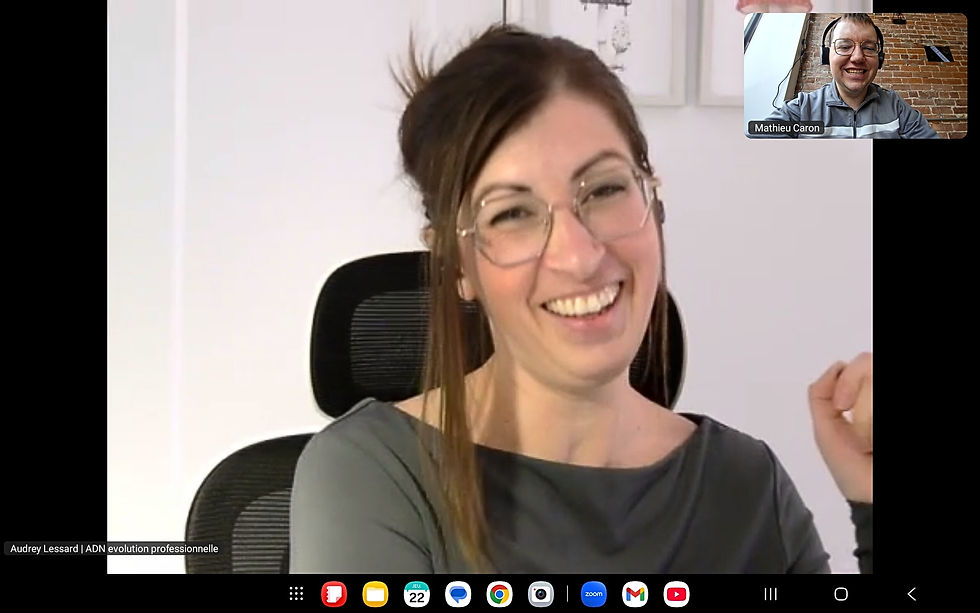
Before meeting Mathieu Caron, interviewer and creator of the "Atypical Interviews" concept, I wanted to understand how he connected with his guests. How he prepared for his interviews. I wanted to get inside his head, even if just for a moment, to draw parallels with the people I work with, those preparing for a job interview or a major career change.
I found it interesting to hear how he prepared mentally, whether he paid attention to non-verbal cues and what he focused on first. What intrigues me most about him is his ability to make people feel comfortable on screen, while gently pushing them out of their comfort zone, or sometimes even less gently, I'll let you discover that for yourself.
There was also in this exchange, as in his atypical interviews, something profoundly uninhibited in his way of talking about autism: a posture of exploration, of curiosity, without pretension and without taboos. A way of saying I'm still learning , rather than I know .
His answer confirmed this to me.
We met virtually last week and listening to him talk about preparation and adaptability, his reality, his evolution, what struck me was how much he spoke from a clear knowledge of himself.
He knows his strengths and his weaknesses. He has a head full of projects, but above all, a great clarity on how he operates. He knows what he needs to perform, to connect with others, to prepare himself mentally, what works for him and what doesn't.
This maturity struck me, especially since it doesn't come from fifty years of experience. It seems to have been built up through experiences, adjustments, trial and error, and above all, a real openness to wanting to improve and do things differently when something no longer works.
At one point, when he mentioned his ability to read non-verbal cues, I was surprised to realize how deeply ingrained certain preconceived notions can still be, even when you think you're open-minded. It was as if, subconsciously, I had associated certain difficulties with a norm rather than with individuals, who are all different.
This conversation reminded me of something essential: there isn't just one way to be attentive or connected to others. There are unique ways, which develop and become more comfortable with over time.
Perhaps true competence is not about conforming to a standard , but about knowing how one functions and daring to build from there.
A few bursts of conversation
To give a more concrete overview of our exchange, here are some excerpts, as Mathieu formulated them.
Q: How do you prepare before an interview?
R: Honestly, I work 99% on instinct and 1% with a structure. I don't prepare by writing down questions word for word. What I do is try to get inside the head of the person I'm going to meet. I try to understand who they are, how they operate, what might put them at ease, or unsettle them just enough to get them to be themselves.
Q: You pay a lot of attention to voice and non-verbal communication. Why?
R: As soon as I hear someone's voice, I make connections. I associate them with people I've known in my life, often since childhood. During the interview, I observe the silences, the hesitations, what's happening in their body language. Not to analyze, but to know when to adjust or change direction.
Q: Why not send the questions in advance?
A: Because I want to avoid prepared answers. When I send questions, it's several months before the interview, so people don't reread them right before. What interests me is what emerges in the moment. Authenticity, not performance.
Q: Has improvisation ever saved you from feeling unwell?
R: Often. There are times when you feel something isn't working. That's when you adjust. For me, improvising is a form of respect. It's listening in a different way.
A way of inhabiting encounters
There's a phrase he mentioned that sums up his character quite well:
"Every opportunity is a learning experience. Every failure deserves to be celebrated."
I love the angle of celebrating. For me, I also see it as a way to move forward without regrets, even when it's not easy, even when it's destabilizing.
Q: How do you look at mistakes today?
R: I don't really see them as mistakes anymore. At the time, it's uncomfortable, yes. But looking back, each situation has led me exactly to where I am today.
Q: If there was one sentence to summarize your vision?
R: We are all different. So, ultimately, difference doesn't exist.
My takeaway from this
Perhaps, ultimately, we are all looking for a space where we can be fully ourselves, without having to justify ourselves.
This is exactly what Mathieu Caron's atypical interviews allow and what I wanted to create with this first meeting of the offbeat conversations: a place where performance gives way to understanding, where we can speak truthfully, where certain taboos, around difference, non-linear paths, neurodivergence, are undone almost naturally.
What if this were as true in job interviews as it is in real life?
Because at the end of the day, what we're looking for isn't to perform well, but to feel understood.
And that changes everything.
A brief aside before we part ways
The name "Les rendez-vous déjantés" (offbeat conversations) came about during this conversation. We brainstormed, somewhat spontaneously, and when Mathieu suggested it, I was surprised, in a good way. It wasn't what I had initially envisioned, and yet, everything fell into place. The tone and the space I wanted to create. Especially since one of my "resolutions" this year is to add an extra touch of "silliness," to my life and my projects.
So thank you to Mathieu for not only agreeing to launch this series with me, but also for contributing, in his own way, to giving it a name and momentum. I couldn't have wished for a better first encounter to launch this project.
See you very soon for the next meeting.
To view the atypical interviews, here is the link:


Comments