

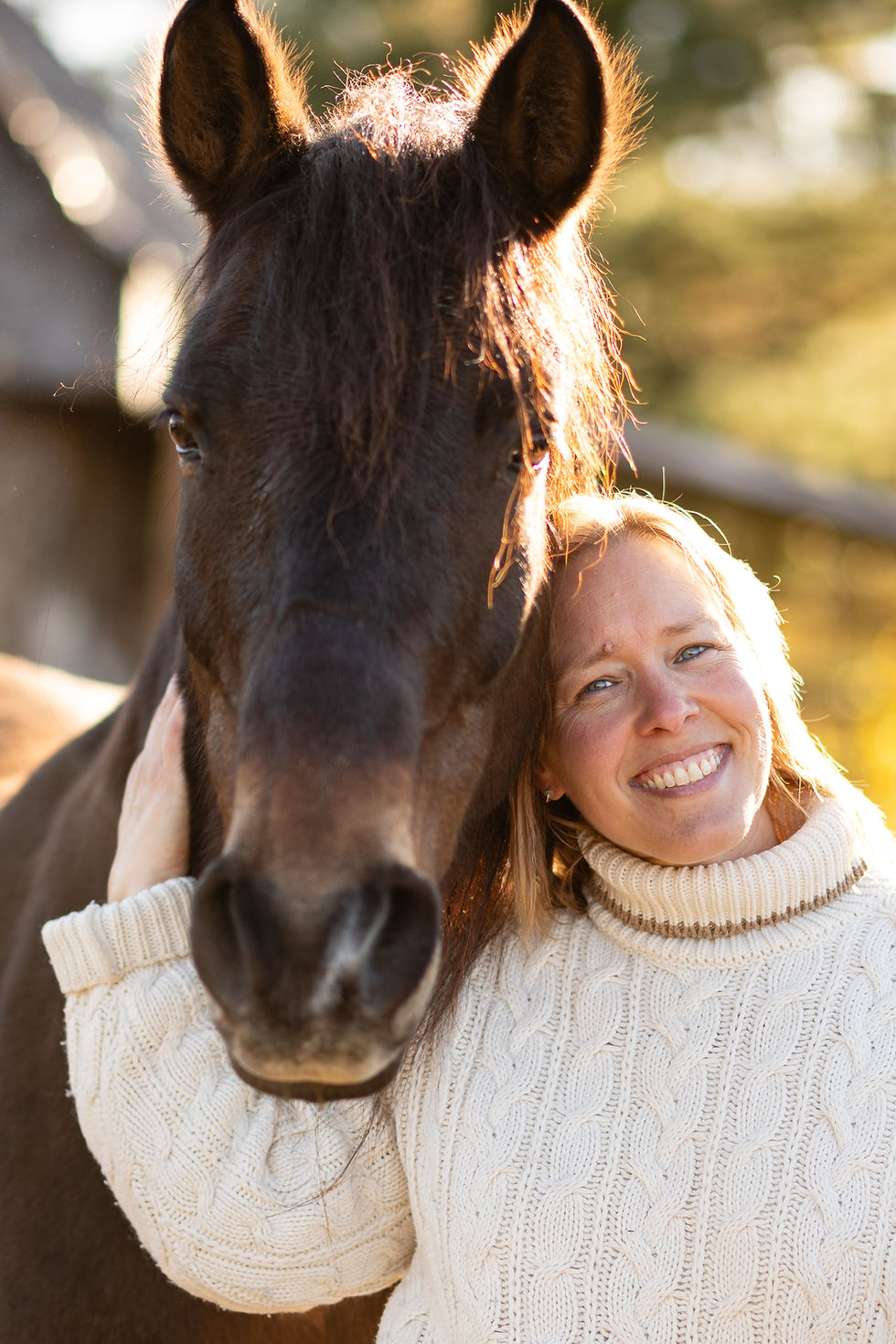
Elsie Côté: At home in her own life

''We talk a lot about living our emotions. But inhabiting them is different. Inhabiting your life. Inhabiting your emotion.''
- Elsie Côté
It's one of the first things she said to me.
And I knew, in that moment, that this conversation was going to stay with me.
Behind Sirote-moi, Plancha Québec and Mme Slush, there's Elsie.

Sometimes, we meet people through what they create, through their professional world.
You hear about Sirote-moi inc. You stumble upon the Plancha Québec community somewhere in a Facebook feed. You discover Mme Slush through some playful project. And you build an image: a prolific entrepreneur, a woman who creates concepts that take off, someone who knows how to put herself out there.
What you don't see is everything it took for this woman to accept being seen.
Elsie Côté lives with three rare diseases that she prefers not to name. They place her in a situation of disability: her body fluctuates, so does her mobility, and certain gestures require strategy. To this is added a neurodivergence whose diagnoses came late, in adulthood. She's a single mother of two neurodivergent children. Each of them carries two of the three rare diseases she lives with. "We're zebras of body and mind," she says.
A former clinical nurse. A former CEGEP nursing instructor. She accompanied, observed, supported, before living in her own body what diagnoses that transform one's relationship to self really feel like.
With her, I wanted to start with her. Not with the businesses.
"If you had to introduce yourself without naming any of your businesses, what would you say?"
She smiled. And the conversation that followed kept me awake long after the call ended.
Before meeting her
We all have versions of ourselves we deploy when life hits hard, when life shakes us up. One that takes the blows. One that makes people laugh. One that works, one that reassures, one that hides. We sometimes call them personas, sometimes armour. Most of the time, we don't even see them. We inhabit them without knowing.
The problem comes when they end up taking up the space that the whole person, behind them, no longer dares to claim.
What struck me about Elsie is that she's making her way back.
Three personas, one person
Mme Plancha came first, and she came through other people.
A few years ago, Elsie had just bought a plancha, a cooking appliance that worked around her dexterity issues. She wanted to share that with a small Facebook group she thought was private. A few months later, the Plancha Québec group counted several thousand members. There she was, in pyjamas and a robe, not recognizing herself as a "networker," watching it all unfold with a mix of disbelief and amusement.
Someone, somewhere, called her "Mme Plancha." And the nickname stuck.
Today, Plancha Québec has become a space she runs: contests, content, workshops, a community gathered around a table.
Mme Slush, on the other hand, was born from a decision.
At a moment when her body was giving out, when one of her illness's symptoms was taking up a lot of room, Elsie created this character as a permission slip. Permission to be playful, funny, creative, when she thought of herself as "not creative in life."
And then there's Mme Côté, about whom someone once asked: "Mme Côté, what does she have?" Elsie had answered, without hesitation: "Mme Côté, she has nothing."
Today, the exact opposite is happening.
"I just realized that Mme Slush and Mme Plancha, they're actually one person. And yes, I am creative."
What she's telling me is the story of a woman who's bringing her personas back home. She realizes that what she had delegated to characters, the boldness, the creativity, the ability to take up space, had been within her all along. Elsie Côté already contains it all. She no longer needs a costume, no longer needs armour. She's decided to take up the whole space.
The word she no longer wants to hear
Early in our exchange, Elsie set a boundary:
"Resilience. It's a word I really struggle with, because often, we don't really choose it."
Resilience, she says, is a word we use in the past tense. "You were resilient." As if it's done. As if it's clean. But in the moment, "there was anger. There was distress. There was a lot of help."
That last sentence is what stopped me. A lot of help. We often prefer the solo version, the heroine who pulls through on her own. Elsie refuses to lie about that. No one rises alone, and continuing to make people believe otherwise keeps alive the idea that those who don't make it just didn't want it badly enough.
The word she prefers, the one that becomes the thread running through everything she tells me, is inhabit. But inhabit what, exactly? Inhabit how?
Powerlessness
Listening to her speak about powerlessness, I had the rare sensation of hearing someone who had truly inhabited the word before sharing it with me.
Before becoming an entrepreneur, Elsie was a clinical nurse, then a CEGEP nursing instructor. She saw, on the front lines, what it means when a diagnosis falls. And she noticed there was always, at one moment or another, the same sentence coming out:
"I'm completely naked." "But it's funny, because you're alive. You have a body. You have a soul, your being. All of it is fully there."
What she describes, she observed in others before living it in her own body. When her legs began to function less well, she first asked herself what her legs were for if she could no longer run, then if she could no longer walk. And the answer she eventually found is as powerful as the question: you remain whole no matter what happens to your body. Every part of yourself has value, even with limitations.
What gets triggered in those moments is rarely the immediate suffering. "When something so intense hits you, you're automatically in the present moment," she tells me. It's what comes after, the thoughts, the scenarios, what it could become, what it will never be again, that creates the fall.
Elsie has trained herself, and that's the right word, trained, to slow down in those moments. To resist the rapid instinct that wants a solution right away. To stay where it's uncomfortable, just long enough to see what appears.
"That's where you see more options."
Inhabiting powerlessness asks you to look it in the face long enough for it to show you what's behind. An option you didn't see, a call for help you weren't allowing yourself, or a truth you were avoiding.
The day after the stage
On February 28, 2026, Elsie gives the opening keynote at International Rare Disease Day, organized by the RQMO (Quebec Rare Disease Coalition).
She has known since September that she'll be on stage. She arrives with a paper folded in two.
I watched the rebroadcast on YouTube. She places her notes beside her, and for nearly an hour, she doesn't touch them. She speaks about her reality with a coherence that holds the room in suspense. She is there, you can see it in her eyes.
Toward the end, she glances at her paper, the way you check a list.
She'll tell me later that she has "stage fright in life."
On screen, I see something else, exactly what she described to me when she spoke of inhabiting her life.
After the conference, a mother comes to see her. She tells her that what she just heard is going to help her daughter.
The next day, Elsie goes home, and everything comes down.
"The next day was hard. I came back home, then the collapse."
She pauses.
"I realized how much we don't have a model. How much my voice was more necessary than I thought."
Then this sentence:
"If I don't do it, who will?"
A weight.
For a long time, Elsie learned not to appear.
Her childhood in Bas-du-Fleuve, where she was often the only Black person in the room, left her with a clear imprint: drawing attention could come at a cost. Later, other observations were added, certain leadership models that didn't resonate, a fear of becoming someone she wouldn't recognize.
"I was afraid that, by taking up space, I'd become what I didn't want to be."
So she held herself back. Until entrepreneurship came and shifted the balance. And until this invitation to take the stage arrived.
In one hour, something shifts. She moves from someone who hides to someone people seek out.
She takes a full day, afterward, to stop and let the experience settle in. And from that space, something keeps unfolding.
Inhabiting powerlessness. That's what it looks like.
What she wants her children to know
When I asked her what she wanted her children to know, the thing she would have wanted to learn earlier herself, she answered without hesitation.
"They have a superpower over their lives."
No matter what awaits them, she says, their ability to create their own path is within them. To trace their way, to do things their way, if that's what they feel like.
For a long time, she doubted being a good mother. She wondered whether her children deserved a mother with full physical abilities. Today, she has set that question down. She realizes she's transmitting other things to them: listening to the body, maintaining balance, the taste for life, the capacity for wonder even when the outside world is more restricted. The permission, above all, to not let oneself be defined by what one can't do.
A foundation as legacy
Elsie is building a foundation.
She hasn't yet revealed the name publicly. She is in the construction phase: board of directors, charitable status, legal structure, choice of projects. Everything you don't see, and that takes time before an organization can truly exist.
What struck me is that she doesn't experience it as a personal project.
"It's not my project. It's a seed I'm planting. The organization has its own life."
The angle of the foundation is to brighten daily life. To help people living with a rare disease or a disability inhabit their lives, to keep what Elsie calls their "little dreams." Because according to her, "as long as we're alive, we should always have a little dream, aspirations, something that makes sense." When I asked her what this foundation represented for her, she answered without hesitation:
"It's the legacy. It's the most beautiful reward I can imagine."
The realization came as she moved forward with the project: the foundation carried the same values as her former profession as a nurse, helping others. Care never left.
The offbeat questions
"What's the most irrational business decision you've ever made, and the one you're most proud of?"
Elsie smiles. She takes a moment, then sums up 2025 in one sentence: "A foundation and two companies in startup mode." When she was told it was impossible, she did it anyway. As long as she believes in it, it continues. She adds: we always have the power to take pauses, to change direction. We just don't always see it in the moment.
"Since you talk about inhabiting your life, it made me smile, I decided to keep going in that direction. If your life were a house, what would be written on the doormat at the entrance?"
She takes a moment. Then smiles: "Nothing."
She explains that she doesn't like doormats with written messages. No "life is beautiful." No quote. If you come home on a day when life has hurt you, the last thing you need is a doormat telling you how you should feel. She prefers a black mat, practical, without a message. What matters is the atmosphere you find once you've stepped inside: the smells, the music, the light. A house that adapts to you, not a house that dictates your mood.
What you take away from a
conversation like this one
What struck me most, listening to her, is that she's doing for herself what she has always done for others.
For years, she looked at people, cared for them, read them. She saw in them what they didn't always see themselves: the strength that lived within them, their capacity to rise after a wound.
Today, in her late thirties, she turns that gaze toward herself. And she allows herself to inhabit her own rooms, fully, under her own name.
That same intensity, she puts into everything she undertakes. Sirote-moi inc., which she founded in 2023, is the most direct illustration: a company built around "savouring the moment," where alcohol-free is an embraced choice, where each product is designed to bring people together differently. Plancha Québec, Mme Slush, the foundation to come, each project carries the same signature. A way of inviting others to inhabit their lives too.
Toward the end of the interview, I asked her about her personal goal for this period of her life. She answered: "to sit on the throne of my life."
To take back the reins, to stop asking for permission.
Elsie Côté is writing a story of return to self.
That's the kind of conversation you walk away from changed.
To follow Elsie Côté
Sirote-moi inc.: the company she founded in 2023, an online boutique specialized in the world of alcohol-free beverages: ready-to-drink mocktails, functional drinks, lattés, mixology products and much more. Online boutique of alcohol-free beverages | Aperitifs & mocktails
Her February 28, 2026 keynote for International Rare Disease Day is available on the RQMO YouTube channel.
You'll find more portraits of perfectly atypical and profoundly remarkable professionals on The Offbeat Conversations | adnevolution.ca


Comments