

Marie-Noël Côté: the only place where the noise stops

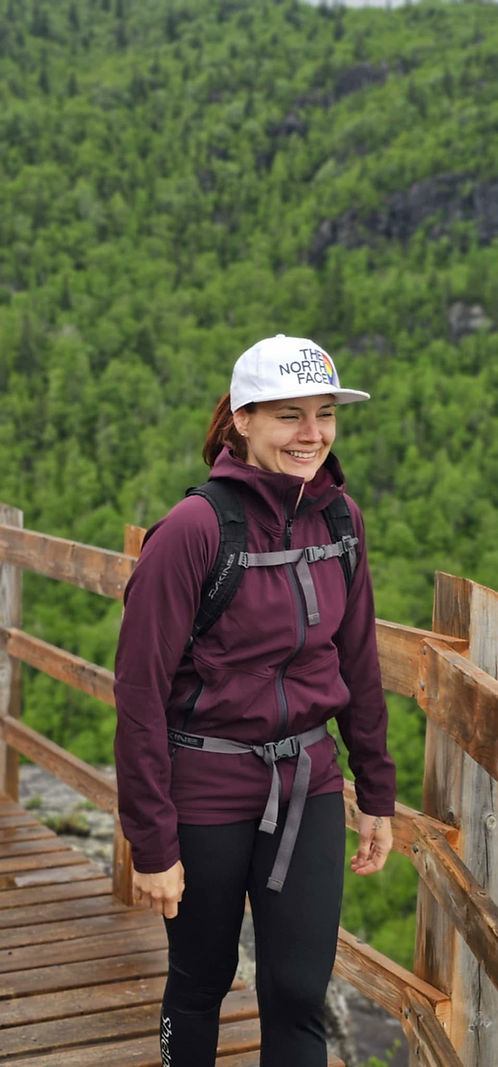
When her face appears on screen, my first thought is a wallpaper.
Leafy trees above her, a ledge of rock behind her back, the light coming through the branches and falling on her face. She is sitting on the ground, surrounded by plants.
She is really there. Outside, sitting on the ground in the forest.
''It's the wallpaper of my life'', she tells me.
I ask her why she chose to do the interview from there.
''It's the only place where the noise in my head goes quiet.''
I have not asked my first real question yet.
And she has just given me a good part of the article.
Without naming her business
I almost always start my Rendez-vous déjantés with the same question. If you had to introduce yourself without naming any of your businesses, what would you say?
She does not answer right away, looks around her, calm.
''I would introduce myself as someone very complex. A mix of things.''
Then it starts coming, as if the first word had unlocked the rest.
Someone who enjoys every single thing passionately and deeply. Someone very curious, who loves to try and to learn.
''I love discovering.''
She tells me about her phone, full of photos of mushrooms and sunsets. Everything that catches her eye when she walks.
She does a lot of sports, but she is also very contemplative. The two live together without getting in each other's way.
Then she says something I did not see coming.
''I have always felt that I was part of it. When I am in nature, I am observing what I am part of.''
Her taste for nature came from her mother. She is trying to pass it on to her daughters in turn. This year, she bought a paddleboard for the oldest one so she could follow her on the water. They leave before supper, sometimes just for half an hour, to go sit on the water and watch the waves.
Her real passion is the human body
Marie-Noël graduated in physical rehabilitation techniques in 2010.
Anatomy, the human body, has always been her passion. She says it without hesitating and she repeats it later in the conversation.
After the diploma, she kept stacking up training. Private trainer, table gymnastics teacher, running training, etc…
She worked just about everywhere. Physio clinics, long term care homes, public health clinics. Private and public, road accident and work accident cases.
Then the profession started getting pushed around. Rights were being taken away from therapists.
She ended up with a pile of training that made her someone very qualified.
And without the right to do what she knew how to do.
''All I was allowed to do was apply heat.''
The clinics wanted her, at a salary that had nothing to do with her qualifications.
She ended up working in four clinics at the same time, in the same week, just to make a salary.
Overload, that is her word.
''My passion makes me live, but now it is making me crash. It is not working, there is something that does not work.''
So she stopped everything.
She walked into a café in Chicoutimi. She stayed there seven years, first as an employee, then as a manager.
And there, something woke up.
When she was young, she had always said that her dream would have been to have a small café.
That is where Canopée Bus Café was born, a mobile café set up in a former adapted transport vehicle, in Saguenay. The first one in the region.Even in Quebec.
It did not exist anywhere else in this form.

But in the Offbeat Conversations, the bus is the setting. Never the subject.
What interests me is the person behind the project. What led her there. Her way of thinking and of seeing things.
And I think that is also what Marie-Noël wanted to show me.
The bathtub that overflows
So I ask her to explain what she meant, a few weeks earlier, when she told me that with a messy brain and some elbow grease, you can do things nobody would have imagined.
She sets a limit before answering.
''I do not have a diagnosis, and I do not want one. Everybody tends to give themselves labels.''
Then she describes.
''I have an enormously creative mind. It never stops.''
There is the load of the business and the load of everyday life. And on top of all that, the projects that often show up at the worst moment.
You have to keep them without losing them. And keep going at the same time with the conversation you are having.
''It is as if for me the drawers were all open all the time, all at once.''
She looks for an image for what comes next. She finds it and she smiles as she says it.
''Sometimes I say that I have a bathtub, and the water in my bathtub overflows. My bathtub is full all the time. I am simply trying to keep the water right at the edge.''
She spills some regularly. It overflows almost every day.
''But for what I keep in the bathtub versus what overflows, I find that it is worth it.''
That is when she tells me about the decision that explains a good part of her path.
''Instead of saying " I have a problem, I am never able to concentrate",
I decided to say: you are not able to concentrate because you really have a lot of ideas sprouting. So use it as a strength.''
She did not try to put a label on it.
She looked at how she worked, and then she decided to work with that.
She hears the cups before building the counter
An empty bus. A floor to lay down, a counter to build. Everything had to be invented, because nothing like it existed.
I wanted to ask her if she sees the finished project in her head before starting, or if it gets built along the way.
She answers before I even finish my question.
''Me, I saw it in my head.''
Even before starting Canopée, she had the whole inside of the bus in her head.
''I did not know how I was going to get there, but I saw it, and I did it exactly the way I saw it.''
Then she adds a sentence that she presents as something silly and that, in the end, is not.
''I often said it as a joke, I hear the cups knocking together. I hear the music that is going to be inside. I cannot explain it to you, but I see it, and I am going to do it the way I see it.''
That is why she made the logo first. Before the business plan and before the numbers.
She needed a visual and a character first. The rest would develop around it.
''Yes, I do it backwards.''
The project took a year to build.
On purpose.
''I really believe in letting an idea settle.''
She is convinced that if she had gone faster, part of what works today would have been rushed.
The ideas needed to simmer.
And for them to simmer, she needed time in nature.
That is why she spends so much time in the forest. Summer and winter, every day.
A brain that never stops, and one single place where it stops.
The project ended up taking exactly the shape of that place.
Because the name of the business is not decorative.
''I created a business to feel good. To create something I love, where I always want to be. It is in there.''
In the bus, she installed a green ceiling. People talked about it a lot, without always understanding.
She points at the leaves above her.
''That is what I recreated. It is being under the canopy.''
She took the place where her head goes quiet and rebuilt it inside a vehicle.
For herself.
And in the end, for other people too.
Two hours in the woods, thirty minutes of work
She called me back after our interview to clarify something.
She wanted it to be in the article.
And she was right.
Canopée has already been told elsewhere. The history, the project, the media have talked about it.
This, never.
And we both agree; we do not talk about it enough.
It took her years to admit to herself that she does not work like most people.
Sitting in front of a computer all day does not make her efficient. For carrying things out, maybe. For thinking, never.
For a long time she resisted that conclusion because of social pressure.
You have to work.
It has to look like work.
She ended up testing another method.
When she is stuck on a project or on a situation to sort out, she leaves.
Two hours in the forest or on the water.
She finds the solution along the way, almost every time.
The noise goes out. She starts thinking again.
Then when she comes back, she gets through in thirty or forty minutes what would have taken her six hours sitting in a fog in front of her screen.
She knows what it looks like, from the outside.
A woman who takes off here and there in the middle of the week. An hour of paddleboarding. A meal grabbed on the go. A lot of time outside.
It can give the impression that she works whenever she feels like it.
She wants people to understand what is really going on.
It is her method.
She tried the standard forty hour week. She measured.
Seven, eight, ten hours of work broken up by time outside produce more, according to her, than forty hours spent in front of a screen because that is what we consider a real work week.
And she goes further.
That is when she asked me a question I am still turning over in my head.
Is this a neuroatypical thing? Or a way of working that society should normalize?
Why don't you take a van?
Here is the part I was not expecting.
I ask her about the trigger moment. The famous flash, the vision.
''I always dreamed of having a café. But the idea of the bus, I am not the one who had it.''
We are in the middle of the pandemic.
All the commercial spaces are closed. The restaurants too.
She wants to start a café. She cannot start a café.
Someone suggests she start with the mobile side in the meantime.
Good idea! She looks into how to set that up in a car.
Then one day, hiking with her brother, he says:
Why don't you take a van?
One thing leading to another, the van becomes a small bus.
''Once I saw the bus in the seller's yard, then the image came into my head. I went: OK, I want it like this.''
And her conclusion:
''The project was built through conversations. It is not me, I did not have a stroke of genius. It really got built with the people around me.''
She stayed open to other people's ideas, even when they did not seem to have anything to do with what she had in mind.
''You never know when a good one is going to come by that could be phenomenal. So I always stay open to everything people tell me. It does not mean I am going to take it. But I listen, I listen all the time.''
A brain where all the drawers are open at the same time also catches what other people drop.
The hardest door
Earlier in our conversation, she told me that when someone puts a door in front of her face, she tends to want to break it down.
Taurus, she points out.
So I ask her which one was the hardest to break down.
The answer comes before I finish my sentence.
''The market. Because people did not understand what it was.''
She saw it, herself.
Nobody else.
''The little girl who comes out of nowhere and says: I made a bus, and I am going to sell coffee in it.''
She takes a second and pulls a face to show me the look she got every time.
A tense, skeptical face. The kind of huh? that people do not say out loud.
Family, friends, business people, chambers of commerce.
''Nobody understood.''
It took three years before the concept became readable for other people. One person at the business services office of the MRC believed in it right away and gave her the right tools. She still names her spontaneously, years later.
The rest of the time, she moved forward with an image in her head that she was the only one to see.
''The crux of it, when you create something that did not exist before, is convincing people that it is going to work.''
Except that she never tried to convince anyone with advertising.
No radio ads. No TV ads. No paid posts. Nothing.
It was a decision.
''It is hard to show an experience on the radio. And for us, everything rests on the experience of living it.''
Saying ''I have a bus café'' did not work. People pictured a yellow school bus with benches.
So she stopped explaining.
She waited.
''If you do not come in, you will never know. But when people come in, they remember it their whole life.''
People around her found it counterproductive, but she held her line.
And here is the detail I will not forget.
The bus windows are tinted.
From the outside, you cannot see inside. From the inside, she saw everything.
''I watched them come out, then go talk about it to other people. I watched the reaction after the first sip.''
That advertising, no budget could have bought it.
She spent summers doing that.
The shyest woman in the place
''I am an extremely shy person.''
Going up to someone at the grocery store to say hello, she does not dare.
Painfully shy, those are her words. Afraid of bothering people.
And yet, four years welcoming thousands of strangers into a bus.
''I think that is actually why I maybe also created this kind of business a little. I put on my costume, and then I have fun. Because then, I am allowed to.''
In her model, it is people who come into her space. She never had to go to them.
When I point it out to her, there is a short silence.
''Maybe that is it too. Maybe that is why I stayed back and told myself: people have to come in. There is surely a link there.''
She missed the body
During the four years when Canopée took up one hundred percent of her time, there was something she missed the whole way through.
The human body. The relationship with the body.
So this year, between February and June, she went to Quebec City to do her massage therapy program, on a fast track.
Her old physio clients came back to see her. Her schedule filled up almost right away. She started giving her table gymnastics classes again.
''I am coming back to my first love.''
Massage is necessarily part time. Nobody does forty hours of massage in a week, it is physically impossible.
And she is the one who decides her schedule.
That is what lets her keep the café alive.
A shift that looks strange from the outside, she says. Two worlds that have nothing to do with each other.
Except that she gave me the thread that connects them.
''I think that in life, I was put on earth to do good for people.''
She used to do that with the human body. When she stopped, she found another medium.
What she wanted to say before hanging up
I ask her if there is anything left.
She says yes.
There is one last thing.
''What I find the most fun about this project is that it gives me the chance to see people's colour.''
The festivals and the events, with the thousands of people who came into her bus, opened up her horizons.
''The accents, the ways of speaking, the energy people come in with, the way people are dressed. People's colour, it is incredible.''
Then she says something that stayed with me.
That at some point we should stop trying to fit people into moulds. It kills the colours.
The off the wall questions
Canopée Bus has reached the end of its useful life. She announced it publicly, saying that something else was coming.
What it will be, she is still keeping to herself.
I ask her what she would have engraved on a plaque to put on it before it goes.
She laughs.
There was a notebook in the bus where the team wrote down the most incredible lines heard at the counter.
One of the last ones from this year:
''One hell of a nice lunch box.''
Then I ask her what coffee she serves to someone who told her that her idea would never work.
The answer comes without hesitation.
''I serve them the best coffee of their life.''
I laugh.
She continues, very serious:
''Because they deserve as much as anyone else to see that it works.''
And finally, the most irrational business decision she is the most proud of.
It is the first one, obviously.
Starting from an empty bus and building it up from zero.
There were nights of anxiety. Nights when she woke up saying to herself:
''Am I really putting a vinyl floor in a bus?''
Today, at festivals and events where the large majority of the audience comes from outside the region, technical crews who tour all over Quebec recognize her and wait for her.
People line up and tell her they waited all year to come back.
''It is worth all the nights of anxiety.''
What I take away
On their last shirts, they had printed a slogan:
Just a little imperfect
''With all the constraints we have, there is always something missing for it to be “perfect”. But that is what makes it perfect.''
Making people happy, as a reason for being. You could find that naive.
Except that she proved it the hard way.
What struck me about her is that she listened to her brain.
She noticed that it produced complete images before plans. That it only stopped in the forest.
So she built something that works with that.
She spent four years bringing people into a bus so they would come out a little better than when they arrived.
The bus is leaving, for now, until what comes next.
She keeps going.
That is the kind of conversation you come out of different.
To follow Marie-Noël Côté
Canopée Bus Café - The bus adventure ends this year. What comes next is already being prepared and it is on her pages that it will be announced first.
Espace Mouvement Saguenay - to discover the TCP Table Gymnastics classes, a different postural training method
Empreinte thérapie manuelle - (link to booking) the massage therapy service available in Chicoutimi and Jonquière, by appointment.
Follow Canopée Bus Café so you do not miss what comes next.
You will find other portraits of perfectly atypical and deeply formidable professionals on The Offbeat conversations


Comments